This article by Maria Konnikova begins with a question that many people want to hear the answer to. Figuring out how to function with less sleep is an obsession that is fueled by energy drinks, coffee, and loud alarm clocks. Although her title isn't in the body of her essay, it's an excellent hook that leads the reader into what she's about to discuss and promises the information that will come later in the essay.
She begins with a generous amount of logos, spouting statistics from the Centers for Disease Control and Prevention left and right. She hits the reader with the fact that 15.5 million people fall asleep while driving each month, which makes a compelling argument for finding a way to function with less sleep, especially since 35% of Americans get less than seven hours of sleep per night. The recommended amount is eight. That's a scary discrepancy.
She slowly introduces Dr. Pack, and his journey towards finding the gene mentioned in her title. She uses a narrative mode of writing to describe how he began in pulmonary studies, but felt compelled to help others with his work, and pulmonary studies weren't making an impact. So he did some research on sleep apnea, and that's how he transitioned into sleep studies. Konnikova assumes that her audience is interested both in the "sensationalist" discovery that drew them in, as well as the backstory behind it, so she explains some of the study and how he discovered and tested the gene that allows people to sleep less.
However, there is a saying that if a news article asks a question, the answer is almost always "no". Disappointingly, Konnikova closes her piece with "the best answer may still be the one we don't particularly want to hear: get more sleep -- as often as we possibly can." Though she wrote an interesting article describing a new scientific discovery, her title was a little over-sensationalist. This gene is not something that can be inserted into everyone. Though she wrote a good, interesting article, her title is slightly misleading, which might reduce her ethos in some readers' eyes.
Sunday, December 21, 2014

Sunday, December 14, 2014
TOW #13 - "The Language Instinct" (IRB)
My favorite question to ask bilingual people is "What language do you think in?" From the beginning, though, this book showed me pretty quickly how ridiculous of a question that is. Though I got a little lost in the technical details of noun phrases and how they're laid out and what goes where, I now understand that everyone just thinks in "mentalese" -- a language with representations of concepts without specific words attached to them. I thought an especially interesting analogy that Stephen Pinker introduced was the idea that young children have all these switches in their brain when they're first born. These switches are just waiting to hear the language that the child is surrounded with to begin flipping up and down to create the mental grammar that the child will then plug the vocabulary that they learn into. I thought that was so interesting, because of how natural "blue ball" feels to me, and how strange "ball blue" is. I just had the "adjectives go in front" switch flipped when I was young.
The explanations I've read so far in this book have me wondering whether there is a way to mess with the switches in people's heads to make learning second languages as an adult easier. And I also wonder whether anyone is truly natively fluent in two languages, even if they learned both while they were babies. One of the languages had to flip the switch first, right? Can a person have two mental grammars? My friend Sun, who was raised speaking Korean until fourth grade and then learned English, is very good at both languages, but she tells me that Korean-Americans who grew up learning both at the same time aren't very good at either. I don't know if this is inaccurate anecdotal evidence, but it makes sense with Pinker's mental grammar theory. Young children trying to sort out which rules go with which languages will understandably make a few mistakes, and therefore have some rules inextricably linked with the wrong language from very early on. But learning one set of grammar very well, and then later on deliberately introducing a second seems like it would disturb the first language less.
Something that Pinker does that I like is use diagrams to help illustrate his point. All the grammar jargon can get mixed up and lost in the reader's head, but having pictures to sort it all out can help. The reader can clarify, confirm, or correct what they read with what they see. It's also helpful to universalize what he's talking about. In his writing, he often uses English as an example because it's the language that the reader is assumed to be most familiar with, and it's the language he is most familiar with. However, most of the rules he talks about apply to all languages, so the diagrams give a helpful picture of the overall system and how it works with all languages.
The explanations I've read so far in this book have me wondering whether there is a way to mess with the switches in people's heads to make learning second languages as an adult easier. And I also wonder whether anyone is truly natively fluent in two languages, even if they learned both while they were babies. One of the languages had to flip the switch first, right? Can a person have two mental grammars? My friend Sun, who was raised speaking Korean until fourth grade and then learned English, is very good at both languages, but she tells me that Korean-Americans who grew up learning both at the same time aren't very good at either. I don't know if this is inaccurate anecdotal evidence, but it makes sense with Pinker's mental grammar theory. Young children trying to sort out which rules go with which languages will understandably make a few mistakes, and therefore have some rules inextricably linked with the wrong language from very early on. But learning one set of grammar very well, and then later on deliberately introducing a second seems like it would disturb the first language less.
Something that Pinker does that I like is use diagrams to help illustrate his point. All the grammar jargon can get mixed up and lost in the reader's head, but having pictures to sort it all out can help. The reader can clarify, confirm, or correct what they read with what they see. It's also helpful to universalize what he's talking about. In his writing, he often uses English as an example because it's the language that the reader is assumed to be most familiar with, and it's the language he is most familiar with. However, most of the rules he talks about apply to all languages, so the diagrams give a helpful picture of the overall system and how it works with all languages.
Sunday, December 7, 2014
TOW #12 - "Girl Humor" (Visual)
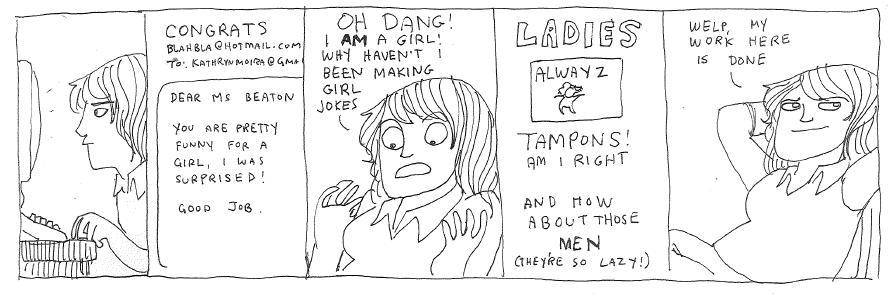
This comic, by Kate Beaton, points out the misogynistic way that humor is considered in the "male domain". Many people just assume that only men can be funny, that female comedians are terrible, that they need to qualify funny women as out of the ordinary. At the same time, she criticizes the way female comedians feel compelled to make jokes solely revolving around their gender, whereas male comedians have a much wider variety of topics. She uses a sardonic tone and parodies "typical" female humor in order to point out how ridiculous the notion that girls can't be funny is.
For some background, Kate Beaton runs a website called Hark! A Vagrant, where she posts comics that often play off of historical or literary themes. It's sophisticated humor that deserves respect, so naturally, random men online harass her about her totally irrelevant gender. She aims to humiliate them with this comic, and show them how ridiculous their "compliment" seems. Her entire website serves as support to her argument, showing that women are capable of sophisticated humor. A lot of the famous female comedians joke about the sorts of things Beaton discusses in the fourth panel because they are expected to, and because if they broke out of that shell, they would receive comments like the ones in the second panel. However, repeating the same jokes about the same tired topics gets boring after a while, which is probably where the "women aren't funny" idea came from, and is perpetuated by close-minded people.
Her last panel also shows the simplicity of the typical female humor, leaning back and acting as though the fourth panel which probably took seconds to make was enough to create humor. However, her real comics actually take time and effort to produce, and she tries to get that across to man who emailed her. People -- male or female -- who put time and effort in the things they create can be equally as funny. Those who simply make easy jokes that are expected of them will not be as funny. Beaton works hard on her humor, and deserves respect worthy of a person, not just a woman.
Subscribe to:
Comments (Atom)